

Walk This Way
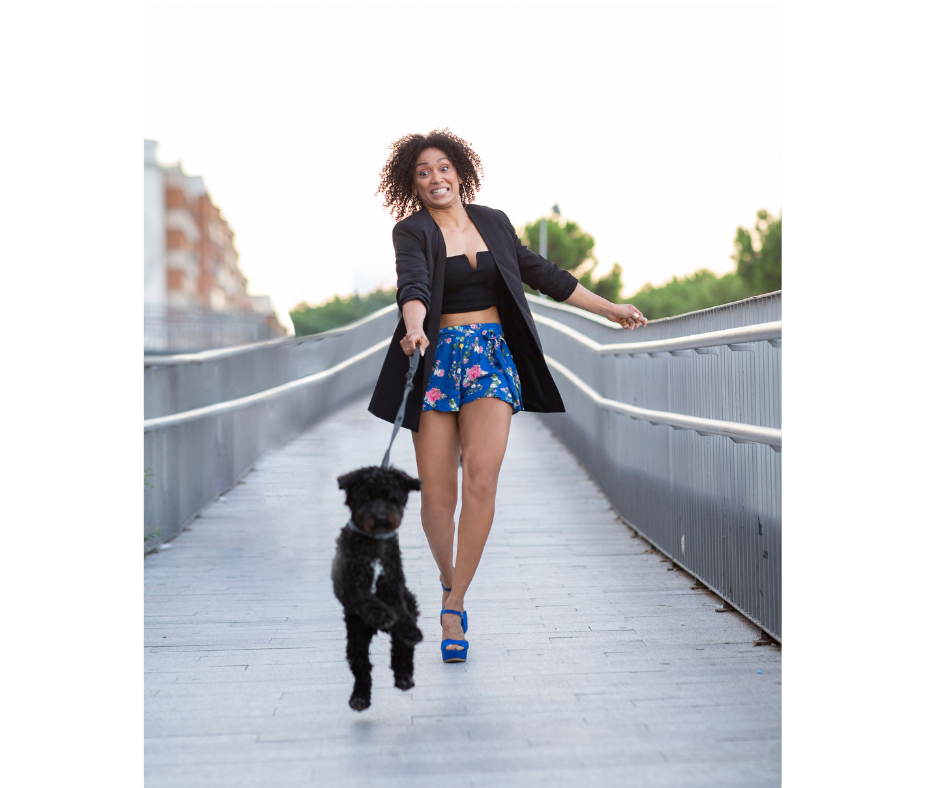
If I had a nickel for every time I heard someone say, “I need help to train my dog not to pull on the leash,” well… I’d be a wealthy woman. And yes, I’m including myself in that group, whining to my trainer about methods to work with my own dogs.
Some dogs are pullers right out of the gate. For others, it’s a learned behavior. And then there are those dogs who just want to get over… there. Occasionally, you hit the jackpot and get the perfect dog who keeps pace with you, making every walk a pleasure. But for most of us? We’re dealing with a dog that pulls, and all we want is a nice, leisurely stroll and not a trip to the ER to pop our shoulder back into its socket.
I get it. I’ve tried a lot of methods to remedy leash pulling.
The Answer?
It’s probably multi-pronged and not the quick fix we’re all hoping for.
The Quick Fix
The quick fix is a prong collar NOT A CHOKE COLLAR. Okay, okay… all my pure-positive friends are cringing. If I’m honest, I am too. It’s the fastest way to stop a dog from pulling, BUT I’ve known dogs who still pull a little even with a prong collar. Additionally, if a prong collar is not used properly, your dog can sustain both physical and psychological harm; an even deeper hole to crawl out of than just the leash pulling.
The Long-Term Fix
Patience. And lots of it.
When I learn something new, I’m 100% sure a good teacher was patient with me. I’m not great at math, but I had a teacher who was great at teaching math. I consistently earned A’s and B’s in Algebra and Algebra II with Trigonometry in high school because he assessed how I learned and didn’t try a quick fix. The result? Positive feelings about math that have lasted decades.
That’s my job as a dog trainer and as a dog owner.
Meet Bruce
Bruce is a leash-puller. God love him. We’ve been working on it for five long years. Sometimes it’s worse than others. I’ve thrown every training technique at him without really assessing the what and the why and then adjusting my training techniques.
Bruce is unapologetically “the Walmart greeter.” People, other animals—he lights up when he wants to visit someone. My job? Teach him what I want from him before we get into that situation.
The 3 D’s of Dog Training
Distance. Distraction. Duration.
When Bruce wants to go over there, I slow down and tell him to “wait.” When he wants to visit someone approaching, I tell him to “wait,” and then give a cue to the person when Bruce is calm and ready for petting. If he can’t maintain a calm state, we reset and repeat the “wait” cue until he succeeds. If he can’t be successful with that level of distraction, we try again later.
Working on this every day is essential. If my dog cannot maintain a calm “wait” with a distraction in the distance, we move farther away until he can be successful. As he improves, we move closer to the distraction until he can maintain the “wait” long enough for someone to pet him without breaking position. If someone pets him and he held the “wait,” we keep the petting very brief so he can be successful, and we can add duration at a future training session.
Start with Loose Leash Walking
We start working on loose leash walking on night one of therapy dog class and for good reason. It’s a core skill for every therapy dog team and often takes the entire class series to master and sometimes longer. Calm, controlled movement isn’t just nice to have; it sets the tone for every visit and ensures safety and comfort for everyone involved.
The technique is simple:
If your dog wants to head over there, ask for a “wait” or turn and walk in the opposite direction.
When your dog takes a few steps without pulling, mark the behavior with a word like “yes” and follow up with a treat.
If your dog is successful, let him know by saying, “good wait.” We all need a paycheck and validation!
This approach teaches your dog that staying close and walking politely earns rewards and that’s part of the foundation for success in therapy work.
How Long Does This Take?
Geesh, Sandy, how long does this take? I wish I could tell you. It depends on the dog and the amount of time you spend working on it.
Also, the Bruce example is just my assessment of my dog. Your dog may have a completely different reason for pulling on the leash. The training piece is the same, though: teaching impulse control can be challenging. I encourage you to work with a seasoned trainer if you need help but most of all, be patient. Your puller most likely didn’t get that way overnight, and it won’t be fixed overnight either.
In the trenches with you,
Sandy
